

Why Won't My Child Just Go to Bed? Another Way to Look at Bedtime Battles
I was sitting in the hairdresser's chair recently when the conversation turned to bedtime. It usually does. Whether you have a baby, a toddler or a ten year old, bedtime is one of those topics that comes up sooner or later between parents.
At some point I asked her, "Do you want me to tell you what I really think about bedtime?"
Here is what I told her. I think we spend a lot of energy trying to change an instinct that is very old, because the rules of modern life say children should go to bed alone, quickly and quietly. But look at monkeys or gorillas. When it is time to sleep, they hold their babies and little ones close.
So if you are wondering why your child won't just go to bed, here is my honest answer. Most of the time there is nothing wrong with your child, and nothing wrong with you. Your child is looking for safety and closeness at the moment of the day when they have to let go of you.
This post won't tell you how to get your child to sleep. It is an invitation to step back, look at bedtime differently, and notice what your child, and you, actually need.
Why bedtime battles happen
We want our children to go to bed and fall asleep straight away. No asking for water, no "I need the toilet", no "I'm hungry", no little feet coming back out of the bedroom.
And the reasons we want that are valid. Maybe you have another child to put to bed. Maybe you need to work or study, you have plans with friends, or you simply need an hour that belongs to you. Whatever your reason is, it is valid. Don't get me wrong about that.
But from your child's side, bedtime is a separation. The water, the toilet, the one more question are often their way of saying "stay with me a bit longer". Babies and children need us. It is instinct, and it is normal.
It doesn't end at three or four either. Children of eight, nine, ten, eleven and older can still need us at bedtime, just in different ways.
One study of children aged four to twelve found that around three in four had fears at night, and that parents often didn't realise how common those fears were.
Every child sleeps differently
We hear so often that children should sleep twelve hours that the number starts to feel like a test we have to pass. I do believe healthy sleep matters enormously for a child's development. But sleep needs change with age and vary from one child to the next, and holding on to one number can put a lot of pressure on us as parents.
I see it in my own home. One of my children could easily go to bed much earlier than his brother. His brother has more energy and finds it hard to fall asleep early. We can run around all day and he is still not ready to sleep at the time I would like him to be.
Research suggests this is more than a feeling. A small study of toddlers found that children whose bodies were ready for sleep later in the evening took longer to fall asleep, and resisted bedtime more, when they were put to bed before that point. Sometimes a child who won't settle simply isn't sleepy yet.
Same parents, same house, same routine, two very different sleepers. Bedtime is a journey that varies from family to family, from sibling to sibling, and from year to year.
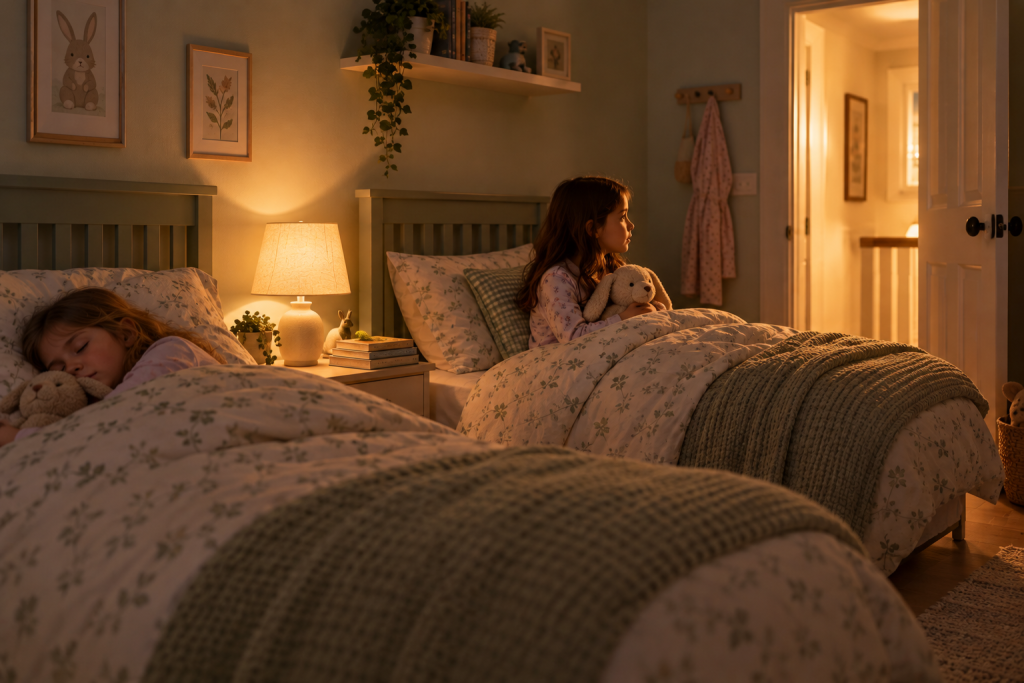
Step back and observe your child at bedtime
Instead of trying yet another tool, I invite you to pause and observe for a week. You don't need to change anything yet. Just notice.
Does your child seem truly tired at bedtime, or still full of energy? What do they ask for once the light is off, and what might be underneath it? Which nights go more smoothly, and what was different about that day? And how are you arriving at bedtime yourself, rushed and running on empty, or with a little left to give?
If you want one small thing to try tonight, ask your child before lights out, "What would help you feel ready for sleep?" You may be surprised by the answer.
What you notice will tell you more about your child than any sleep chart.
Supporting your child without forgetting your own needs
Is it possible to meet your child's need and your own? I believe it is, though not perfectly and not every night.
My five year old sometimes really, really wants me next to him. So I come, and I reassure him as much as I can. And I am honest with him too. I tell him it is mummy's bedtime, that she needs to get ready for bed and read her own bedtime story.
Sometimes he understands. Sometimes he doesn't, and we keep working out how I can support him.
Is it easy? No. Is it tiring and frustrating? Yes. Would I prefer he went to sleep straight away? Of course. But I try to speak to him peacefully so that he feels heard and seen, because I know one of my jobs is to help him feel safe.
This doesn't mean you have to stay next to your child all night. That choice is very personal and there is no judgement here. It is simply an invitation to understand what is underneath bedtime, for both of you.
If you have a baby under one, the Lullaby Trust and the NHS both have clear safe sleep guidance that is worth reading.
Questions parents ask about bedtime
Why does my child keep getting out of bed?
Often because they are looking for you more than for the water, and sometimes because they simply aren't sleepy yet. Bedtime is a separation, and coming back out is a way of checking you are still there. Noticing what they ask for, and when, can tell you a lot about what they need.
How much sleep does my child really need?
Recommended hours are a range, not a single number, and they change as children grow. Some children need more and some need less. If you are worried about your child's sleep, your GP or health visitor is a good place to start.
Is it normal for an older child to still need me at bedtime?
Yes. Many children of eight, ten or older still want a parent close as the day ends. It is often the time when worries come up and when they finally feel like talking.
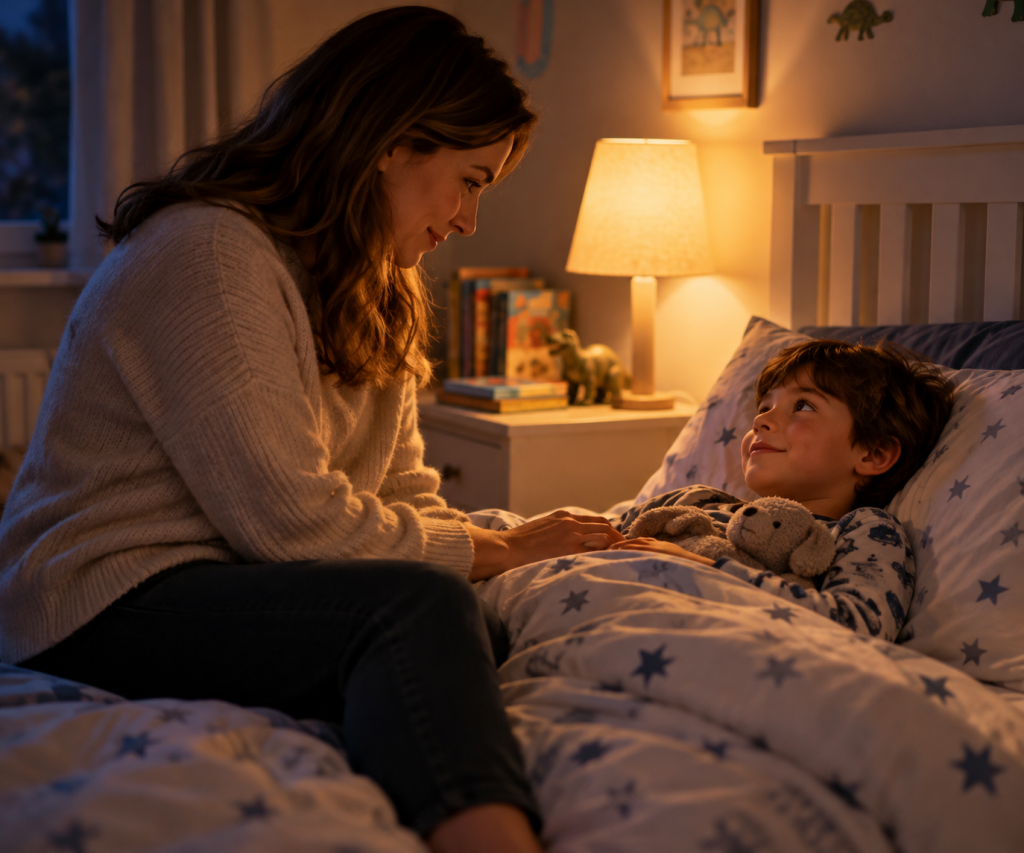
Finding your own way through bedtime
There is no single right way to do bedtime. There is your child, with their own rhythm and their own needs, and there is you, with yours. When you step back and observe, bedtime can become less of a battle to win and more of a moment to understand each other.
It won't be easy every night. But you are not getting it wrong.
If bedtime feels heavy in your home right now and you would like support finding what works for your family, you are welcome to book a call with me. We can look at it together.